
Bookkeeping Process Guide for Small Businesses UK
- David Rawlinson
- Jan 8
- 7 min read

Too many british small businesses fall into trouble simply by overlooking the basics of their bookkeeping. For small business owners and sole traders in Garforth, Leeds, getting the fundamentals right means fewer surprises at tax time and greater peace of mind year-round. With over 40 percent of british businesses facing HMRC penalties due to bookkeeping errors, learning how to set up and maintain accurate records gives you a real advantage and helps your business stay compliant.
Table of Contents
Quick Summary
Key Point | Explanation |
1. Set Up Accurate Bookkeeping Systems | Establish a dual-entry bookkeeping system to track transactions, ensuring compliance with UK accounting standards and improved accuracy. |
2. Organise Financial Documents Efficiently | Develop a systematic strategy for storing financial paperwork with clear naming conventions to save time during tax reporting. |
3. Record Transactions Regularly | Implement a routine for immediate transaction recording to maintain accurate and timely financial records to support informed decision-making. |
4. Reconcile Bank Statements Carefully | Monthly bank statement reconciliation helps identify discrepancies between financial records and bank transactions, ensuring accuracy and transparency. |
5. Review and Verify Financial Records | Conduct a thorough monthly review of all financial documents to ensure accuracy and compliance with current UK accounting regulations. |
Step 1: Set Up Accurate Bookkeeping Systems
Setting up an accurate bookkeeping system is fundamental for small businesses to track financial performance and maintain regulatory compliance. Your goal is creating a reliable method for recording, categorising, and tracking business transactions that meets UK accounting standards.
To establish a robust bookkeeping system, start by selecting an accounting method that aligns with UK accounting practices). The double-entry bookkeeping approach remains the most recommended technique for small businesses, where every financial transaction is recorded in two separate accounts to ensure accuracy and balance. This method helps you track income, expenses, assets, and liabilities systematically.
Here is a comparison of common bookkeeping methods for small businesses:
Method | Description | Suitability in UK | Typical Software Integration |
Double-entry | Records each transaction in two accounts | Strong compliance, preferred | Supported by most UK accounting platforms |
Single-entry | Records transactions only once | Not recommended, lacks rigour | Rarely integrated, limited use |
Cash-based accounting | Records income/expenses when cash changes | Suitable for some sole traders | Sometimes supported, less common |
Begin by opening a dedicated business bank account separate from your personal finances. Collect and organise all financial documentation, including receipts, invoices, bank statements, and payroll records. Choose accounting software compatible with UK tax requirements, which will help you categorise transactions, generate financial reports, and streamline your record-keeping process.
Expert Advice: Implement a consistent monthly reconciliation routine to catch and correct any discrepancies in your financial records quickly and maintain impeccable bookkeeping standards.
Step 2: Organise Financial Documents Efficiently
Efficient document organisation is crucial for small businesses to maintain clear financial records and simplify tax reporting. Your primary objective is creating a systematic approach to storing and managing financial paperwork that saves time and reduces stress during accounting periods.
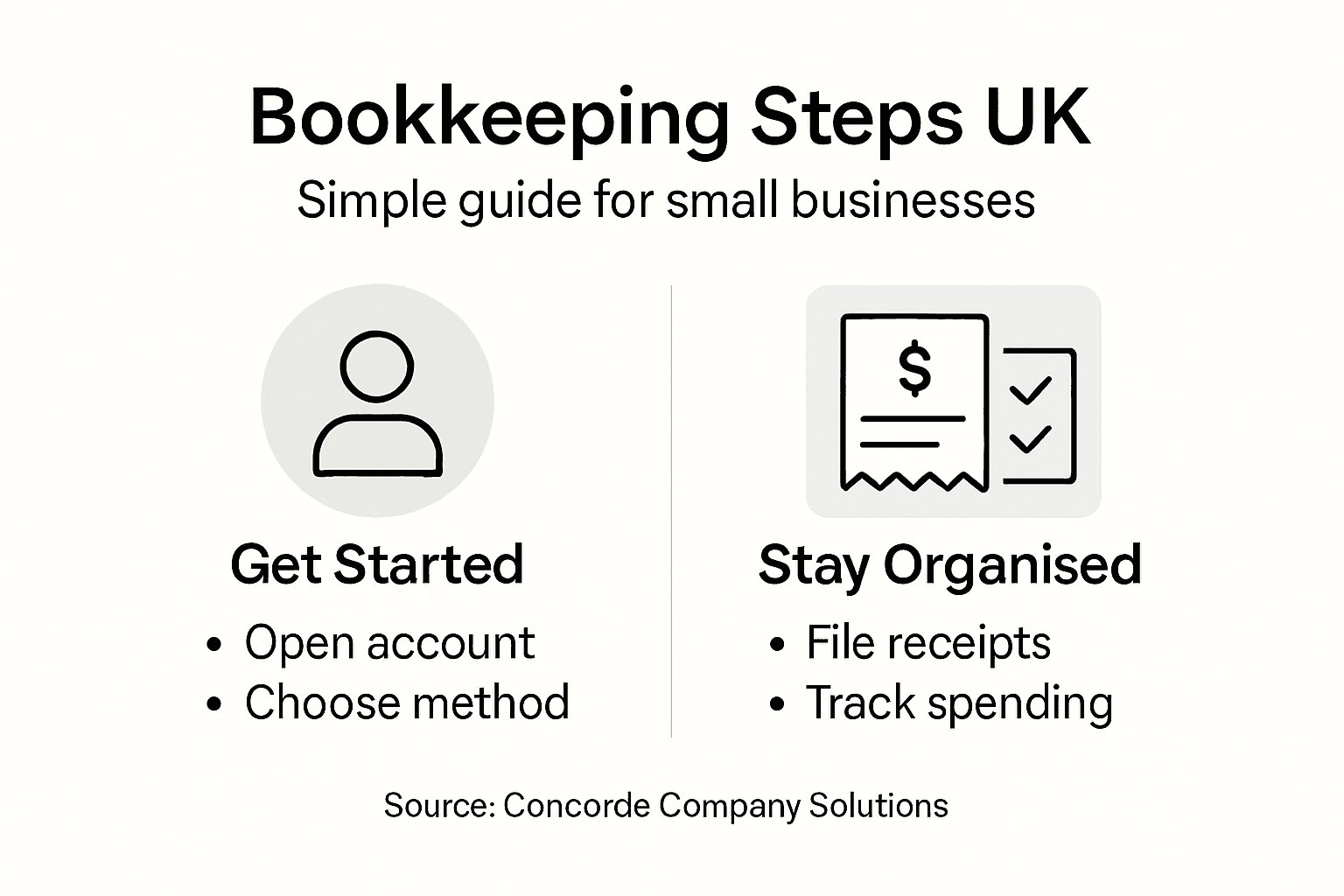
Start by developing a consistent file organisation strategy that includes clear naming conventions and structured digital folders. Create separate digital folders for key document types such as invoices, receipts, bank statements, payroll records, and tax documents. Use a standardised naming format that includes the date, document type, and relevant business identifier to ensure quick retrieval. For example, “2023-07-InvoiceClientX-001” provides immediate context about the document.
Implement a digital filing system that mirrors your physical document storage. Scan all paper documents and store them in corresponding digital folders, ensuring you keep both digital and physical copies for at least six years as per UK tax regulations. Use cloud storage solutions with robust security features to backup your financial documents, protecting them from potential loss or damage.
This table outlines key functions of digital document organisation for financial records:
Function | Business Impact | Recommended Technology |
Consistent naming conventions | Speeds up document retrieval | File automation tools |
Cloud-based file backup | Safeguards records from loss | Secure cloud platforms |
Digital and physical archiving | Meets UK legal retention rules | Document management software |
Expert Advice: Establish a monthly document review routine where you spend 30 minutes organising and filing new documents to prevent paperwork from becoming overwhelming.
Step 3: Record Transactions Regularly
Consistent and timely transaction recording is the backbone of effective bookkeeping for small businesses. Your goal is to create a systematic approach that captures every financial movement accurately and promptly, ensuring your business maintains clear and compliant financial records.

Implement a robust system for recording financial transactions that allows you to document each business transaction immediately after it occurs. Choose between manual entry in a dedicated accounting ledger or utilise accounting software that can automatically track and categorise your financial activities. For cash transactions, keep detailed receipts and log them into your system within 24 hours to prevent information loss or inaccuracies.
Establish a regular schedule for transaction recording. Set aside dedicated time each week to reconcile bank statements, update your financial records, and cross reference transactions. This approach helps identify any discrepancies early and provides a real-time snapshot of your business financial health. Ensure you record all income, expenses, purchases, sales, payroll, and tax-related transactions with precise details including date, amount, description, and relevant category.
Expert Advice: Create a weekly calendar reminder for transaction recording to maintain consistency and prevent last-minute scrambling during tax season.
Step 4: Reconcile Bank Statements Carefully
Reconciling bank statements is a critical financial management practice that helps small businesses maintain accurate financial records and identify potential discrepancies. Your primary objective is to systematically compare your business financial records against official bank statements to ensure complete transparency and accuracy.
Perform a thorough bank reconciliation process by carefully comparing each transaction in your accounting records with the corresponding entries on your bank statement. Start by gathering your most recent bank statement and your internal financial records. Mark off each transaction that matches exactly between your records and the bank statement, paying close attention to transaction dates, amounts, and descriptions. Investigate any transactions that do not align immediately.
Create a structured approach to reconciliation by setting aside dedicated time each month to complete this task. Look for common discrepancies such as bank fees, interest charges, unrecorded transactions, or potential errors in your bookkeeping. Use spreadsheet software or accounting tools to track and document any differences you discover. Investigate and resolve unexplained discrepancies promptly, ensuring you maintain a clear audit trail of your financial activities.
Expert Advice: Keep digital copies of all bank statements and reconciliation notes for at least six years to support potential financial reviews or tax investigations.
Step 5: Review and Verify Financial Records
Reviewing and verifying financial records is a crucial process that helps small businesses maintain accuracy, identify potential errors, and ensure compliance with UK accounting regulations. Your primary objective is to systematically examine all financial documentation to confirm its completeness, accuracy, and alignment with your business operations.
Implement a comprehensive approach to record verification processes that involves a detailed examination of all financial documents. Cross reference bank statements, invoices, receipts, payroll records, and tax documents to ensure every transaction is accurately recorded. Create a consistent monthly review schedule where you carefully examine each financial record for potential discrepancies, unusual transactions, or data entry errors. Pay special attention to matching external documents with your internal accounting records, verifying amounts, dates, and transaction descriptions.
Develop a structured verification checklist that covers key areas of financial record examination. This should include checking for mathematical accuracy, ensuring all transactions are properly categorised, confirming that expenses and income are correctly documented, and validating that all financial records comply with current UK accounting standards. Use digital tools and spreadsheet software to help automate parts of the verification process, but always maintain a manual review to catch nuanced discrepancies that automated systems might miss.
Expert Advice: Create a dedicated folder for verified documents, marking each with the date of review to maintain a clear audit trail for potential future investigations.
Streamline Your Bookkeeping with Expert Support from Concorde Company Solutions
Managing an accurate bookkeeping process can quickly become overwhelming for small businesses aiming to meet UK compliance and maintain transparent financial records. Whether you struggle with organising financial documents efficiently or reconciling bank statements carefully, Concorde Company Solutions understands these challenges and offers tailored bookkeeping services designed to ease your burden. From setting up reliable accounting systems to regular transaction recording and verification, our expert team supports you every step of the way to keep your business finances in perfect order.

Take control of your business finances today by partnering with a trusted local accountancy firm in Leeds. Visit Concorde Company Solutions to discover how our dedicated bookkeeping services can simplify your processes and ensure compliance. Don’t wait until tax season to find discrepancies. Contact us now to receive personalised assistance and build a solid financial foundation for your small business.
Frequently Asked Questions
How can I set up an accurate bookkeeping system for my small business?
To set up an accurate bookkeeping system, begin by selecting the double-entry bookkeeping method, as it records each transaction in two accounts for accuracy. Open a dedicated business bank account, collect all relevant financial documents, and choose compatible accounting software to streamline your record-keeping process.
What is the importance of organising financial documents in bookkeeping?
Organising financial documents is essential as it helps maintain clear records and simplifies tax reporting. Develop a systematic approach to store and manage financial paperwork by using clear naming conventions and structured digital folders to improve retrieval efficiency.
How often should I record transactions for effective bookkeeping?
Record transactions regularly, ideally on a weekly basis, to ensure that all financial movements are captured accurately and promptly. Set aside dedicated time each week to reconcile bank statements and update your financial records to maintain a clear view of your business finances.
What is the process for reconciling bank statements in small business bookkeeping?
The bank reconciliation process involves comparing your internal financial records with your bank statement. Gather both records, match each transaction, and investigate any discrepancies immediately to maintain accurate financial records.
How can I verify my financial records for accuracy?
To verify your financial records, conduct a systematic review of all documentation each month, checking for discrepancies and ensuring compliance with UK accounting regulations. Create a verification checklist that includes key areas such as mathematical accuracy and proper categorisation of transactions to streamline this process.
What tools can assist in managing bookkeeping for small businesses?
Utilise accounting software or spreadsheet applications to assist with transaction recording, document organisation, and financial record verification. These tools can automate parts of the process, but always incorporate a manual review for comprehensive accuracy.
Recommended

Comments