
Statutory Accounts Preparation Steps for UK Compliance
- Richard Ellis
- Feb 16
- 8 min read


Keeping up with statutory account preparation can feel overwhelming, especially with the detailed requirements set by UK regulations. Getting this right matters for accountants and financial managers across Garforth and Leeds, as it secures your business against potential issues with Companies House or HMRC. This guide clearly explains each step, from gathering financial records to submission, so you can maintain compliance with UK accounting standards and safeguard your company’s reputation.
Table of Contents
Quick Summary
Essential Insight | Detailed Explanation |
1. Gather comprehensive financial records | Collect all relevant financial documents to ensure accurate reporting and compliance with legal requirements. |
2. Organise and reconcile account data | Systematically match your financial ledgers against bank statements to identify discrepancies and ensure accuracy in financial reporting. |
3. Prepare statutory financial statements | Generate formal financial documents required by regulatory bodies, ensuring compliance with relevant accounting standards for your company size. |
4. Conduct a thorough review and verification | Carefully review all accounts for accuracy and consistency, focusing on unusual transactions and compliance with statutory requirements. |
5. Submit accounts on time | Ensure complete and accurate submission of statutory accounts to relevant authorities, maintaining compliance and reflecting professionalism in your business dealings. |
Step 1: Gather essential financial records
Preparing your statutory accounts begins with meticulously collecting and organising all your financial documentation. This critical first step ensures you have a comprehensive overview of your company’s financial performance and provides the foundational materials needed for accurate reporting to Companies House and HMRC.
To gather your essential financial records, focus on collecting key documents that provide a complete picture of your business’s financial activities. These include:
Bank statements for all business accounts
Sales invoices and receipts
Purchase invoices and expense records
Payroll documentation
Asset registers and depreciation records
Stock inventory logs
Credit card statements
Loan and financing documentation
The company and accounting records maintained by UK businesses must be accurate, comprehensive, and stored securely. Each document serves a crucial role in constructing your statutory accounts, demonstrating financial transparency and compliance with legal requirements.
Organise these records chronologically and ensure they cover the entire financial year. Digital storage systems can help streamline this process, making document retrieval easier during account preparation. Keep copies both electronically and in physical format to maintain robust financial documentation.
Maintaining detailed, well-organised financial records is not just a legal requirement—it’s a strategic practice that provides insights into your business’s financial health.
Pro tip: Consider using cloud-based accounting software to automatically categorise and store financial documents, reducing manual filing time and minimising the risk of lost records.
Step 2: Organise and reconcile account data
After gathering your financial records, the next critical phase involves meticulously organising and reconciling your account data. This process ensures the accuracy and completeness of your financial information before preparing statutory accounts, helping you identify any discrepancies and maintain precise financial reporting.
To effectively reconcile your accounts, follow these key steps:
Match bank statements against your financial ledgers
Verify each transaction’s accuracy and classification
Identify and investigate any discrepancies
Adjust for accruals, prepayments, and outstanding transactions
Confirm all income and expenditure are correctly recorded
The annual accounts preparation process requires careful alignment of your record books with bank statements and financial documentation. This means systematically comparing each transaction, ensuring every pound is accounted for and correctly categorised.
Pay special attention to reconciling complex financial elements like asset depreciation, loan repayments, and inventory changes. Detailed reconciliation helps prevent potential errors that could lead to compliance issues or misrepresentation of your company’s financial position.
Accurate account reconciliation is not just a bureaucratic exercise—it’s a strategic tool that provides clear insights into your business’s financial health and performance.
Pro tip: Consider using automated accounting software that can streamline the reconciliation process and flag potential discrepancies in real-time, saving you significant time and reducing manual error risks.

Step 3: Prepare statutory financial statements
Preparing statutory financial statements is a critical process that transforms your carefully reconciled financial data into formal documentation required by UK regulatory authorities. These comprehensive statements provide a transparent snapshot of your company’s financial performance and position for the accounting period.
Your statutory financial statements will typically include several key components:
Balance sheet
Profit and loss account
Notes to the accounts
Cash flow statement (for larger companies)
Directors’ report
Potentially an auditors’ report
The annual accounts preparation requirements mandate that these statements must comply with specific accounting standards such as FRS 102 or IFRS. Precise financial reporting is essential, with the complexity varying depending on your company’s size and structure.
For smaller companies, the documentation might be more streamlined, while larger organisations will need more extensive detailed financial disclosures. Ensure you’re using the correct accounting framework for your company size, whether you’re a micro-entity, small business, or larger corporation.
Here is a summary of how statutory account requirements differ by company size in the UK:
Account Component | Micro-entity | Small Company | Large Company |
Reporting Standards | FRS 105 | FRS 102 Section 1A | Full FRS 102 or IFRS |
Cash Flow Statement Needed | Not required | Not usually required | Mandatory |
Audit Requirement | No, if eligible | No, if eligible | Mandatory |
Notes to Accounts | Minimal notes | Abridged notes allowed | Full, detailed notes needed |
Directors’ Report | May not be required | Sometimes needed | Mandatory |
Statutory financial statements are more than just paperwork—they’re a strategic communication tool that tells the story of your company’s financial journey.
Pro tip: Consider engaging a qualified accountant to review your draft financial statements, as professional oversight can help identify potential issues and ensure full compliance with UK reporting standards.
Step 4: Review and verify accounts for accuracy
The final critical stage of statutory accounts preparation involves a comprehensive review and verification process to ensure absolute accuracy and compliance with UK regulatory standards. This meticulous examination helps prevent potential errors, penalties, and ensures your financial statements present a true and fair view of your company’s financial position.
Key areas to focus on during your review include:
Checking mathematical accuracy of all calculations
Verifying transaction classifications
Confirming all entries match supporting documentation
Ensuring consistency across financial statements
Validating accounting treatment of complex transactions
Cross-referencing figures between different financial documents
The annual accounts verification process requires directors to carefully approve the final accounts, confirming they meet statutory requirements. Systematic financial review involves a detailed line-by-line examination of each financial statement, looking for potential discrepancies or areas that might raise questions from regulators.
Pay special attention to unusual or significant transactions, ensuring they are properly documented and justified. This might include one-off expenses, asset disposals, or significant changes in accounting policies that require additional explanation in the notes to the accounts.
Thorough account verification is not just about finding errors—it’s about demonstrating the financial integrity and transparency of your business.
Pro tip: Consider creating a detailed review checklist and involve multiple team members in the verification process to reduce the risk of overlooking potential issues.
Step 5: Submit completed statutory accounts
The final stage of statutory accounts preparation involves submitting your meticulously prepared financial documentation to the relevant UK regulatory bodies. This crucial step ensures your company remains compliant with legal requirements and maintains good standing with Companies House and HMRC.
To successfully submit your statutory accounts, follow these key steps:
Confirm all documents are complete and accurate
Prepare digital copies in the required format
Choose the appropriate submission method
Check filing deadlines for your company type
Pay any necessary filing fees
Retain copies for your business records
The annual accounts filing process requires electronic submission, with strict submission timelines varying based on your company structure. Private companies typically have nine months from their financial year-end to file accounts with Companies House.
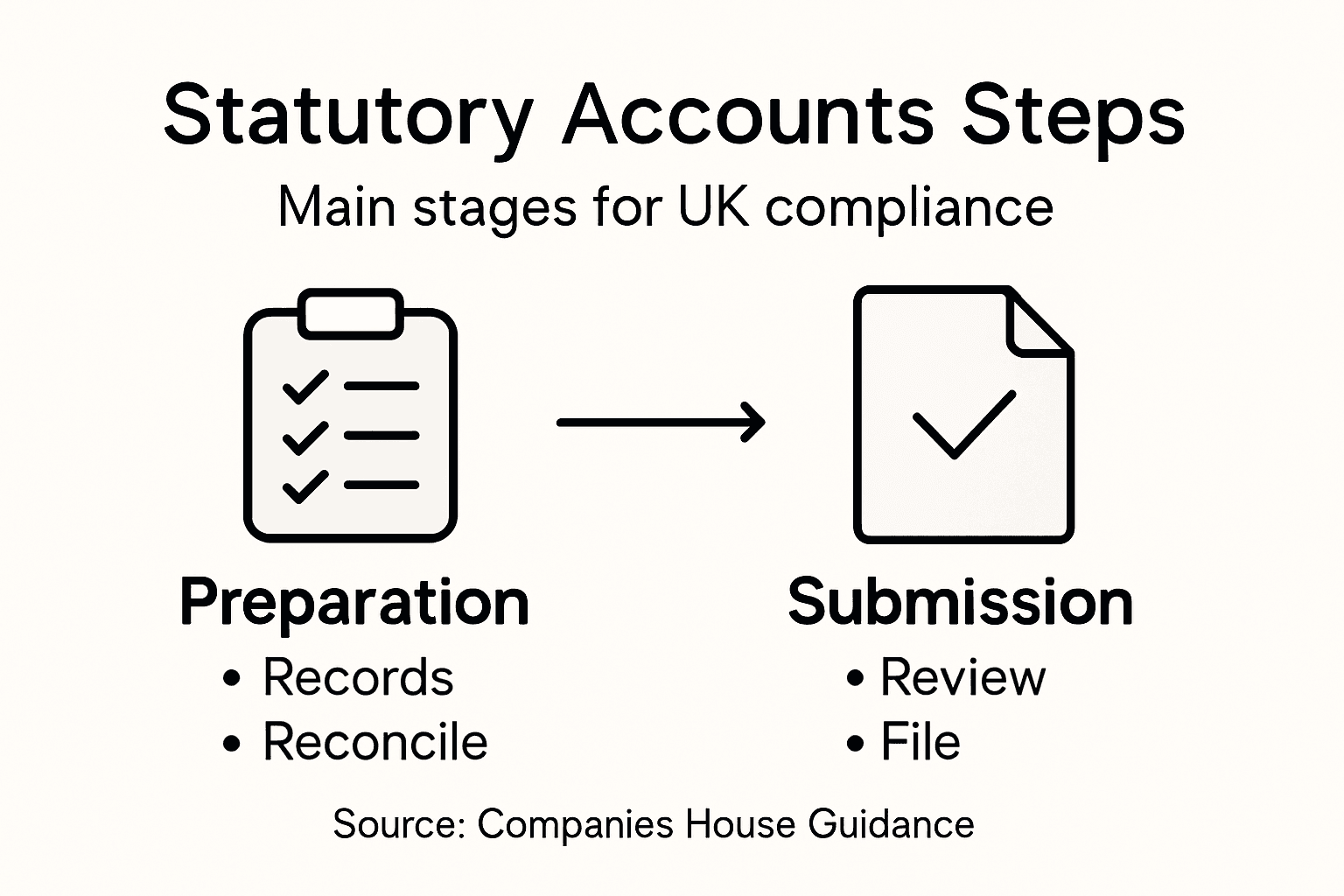
Prepare digital versions of your accounts using compatible filing software approved by Companies House. Ensure all required documents are included, such as the balance sheet, profit and loss account, directors’ report, and any necessary accompanying notes.
Below is a quick reference to key statutory filing deadlines and penalties in the UK:
Filing Event | Private Companies | Public Companies | Late Filing Penalty |
Accounts Due After Year-End | 9 months | 6 months | £150 to £1,500, escalating |
Corporation Tax Due | 9 months and 1 day | 9 months and 1 day | Daily interest charges |
Confirmation Statement Due | Every 12 months | Every 12 months | £150 (fixed) |
Penalty Escalation | Doubles if late 2 years in row | Doubles if late 2 years | Double penalty |
Timely and accurate submission is not just a legal obligation—it’s a reflection of your business’s financial professionalism and commitment to transparency.
Pro tip: Set calendar reminders at least two months before your filing deadline to give yourself ample time for final checks and potential corrections.
Simplify Your Statutory Accounts Preparation with Expert Support
Preparing statutory accounts demands careful organisation, detailed reconciliation, and strict compliance with UK accounting standards. If you find yourself overwhelmed by the complex requirements such as accurate financial statements, verification processes, and timely filing deadlines this is where professional help can make all the difference. Concorde Company Solutions understands the challenges small to medium-sized businesses face when navigating these critical steps and specialises in delivering tailored accounting solutions to meet your exact needs.

Take the stress out of statutory accounts preparation by partnering with a trusted Garforth-based firm that offers transparent pricing and personalised support. Whether you need assistance gathering essential records, reconciling accounts, or submitting completed statements on time, our expert team is ready to ensure your business remains fully compliant with HMRC and Companies House requirements. Visit Concorde Company Solutions today to discover how our comprehensive accounting services can streamline your financial operations and give you peace of mind. Act now and secure reliable expertise that transforms statutory reporting from a burden into a strategic advantage.
Frequently Asked Questions
What are the essential financial records needed for statutory accounts preparation?
To prepare statutory accounts, you need to gather key financial records such as bank statements, sales and purchase invoices, payroll documentation, and asset registers. Collect these documents to ensure a comprehensive overview of your company’s financial activities, which are essential for accurate reporting.
How do I reconcile my account data effectively?
To reconcile your account data, match your bank statements with your financial ledgers, verifying the accuracy of each transaction. Ensure all entries are properly classified and investigate any discrepancies to maintain precise financial reporting.
What components should be included in my statutory financial statements?
Your statutory financial statements should include a balance sheet, profit and loss account, notes to the accounts, and, for larger companies, a cash flow statement. Prepare these documents in compliance with the relevant accounting standards to accurately reflect your company’s financial position.
How can I ensure the accuracy of my statutory accounts before submission?
To ensure accuracy, carry out a thorough review of your statutory accounts, checking for mathematical errors, transaction classifications, and consistency across documents. Create a comprehensive verification checklist and involve multiple team members to minimise the risk of oversight.
What steps should I follow to submit my completed statutory accounts?
To submit your statutory accounts, confirm all documents are complete and accurate, prepare digital copies, and check submission deadlines for your company type. Ensure you retain copies for your records and follow the appropriate filing procedures to maintain compliance.
Recommended


Comments