
Bookkeeping vs Accounting: Clarifying the Key Differences
- David Rawlinson
- Dec 23, 2025
- 7 min read

Most british small business owners are surprised to learn that nearly 40 percent admit confusion between bookkeeping and accounting. This uncertainty can create missed opportunities for informed decisions in Leeds and Garforth businesses. Understanding the difference sharpens your financial focus, helps you meet compliance with confidence, and lets you leverage the right expertise for your business size and goals.
Table of Contents
Key Takeaways
Point | Details |
Distinct Roles | Bookkeeping focuses on meticulous transaction recording, while accounting involves interpreting and analysing financial data for strategic insights. |
Legal Responsibilities | Both bookkeepers and accountants must adhere to stringent regulatory standards, ensuring accurate financial documentation and compliance with HMRC. |
Cost Considerations | Small businesses should evaluate the cost and value of bookkeeping versus accounting services, as professional support can save money in the long run. |
Selecting Support | Tailor financial support to your business stage; sole traders may need basic bookkeeping, whereas expanding companies require comprehensive accounting services. |
Bookkeeping and Accounting Defined Clearly
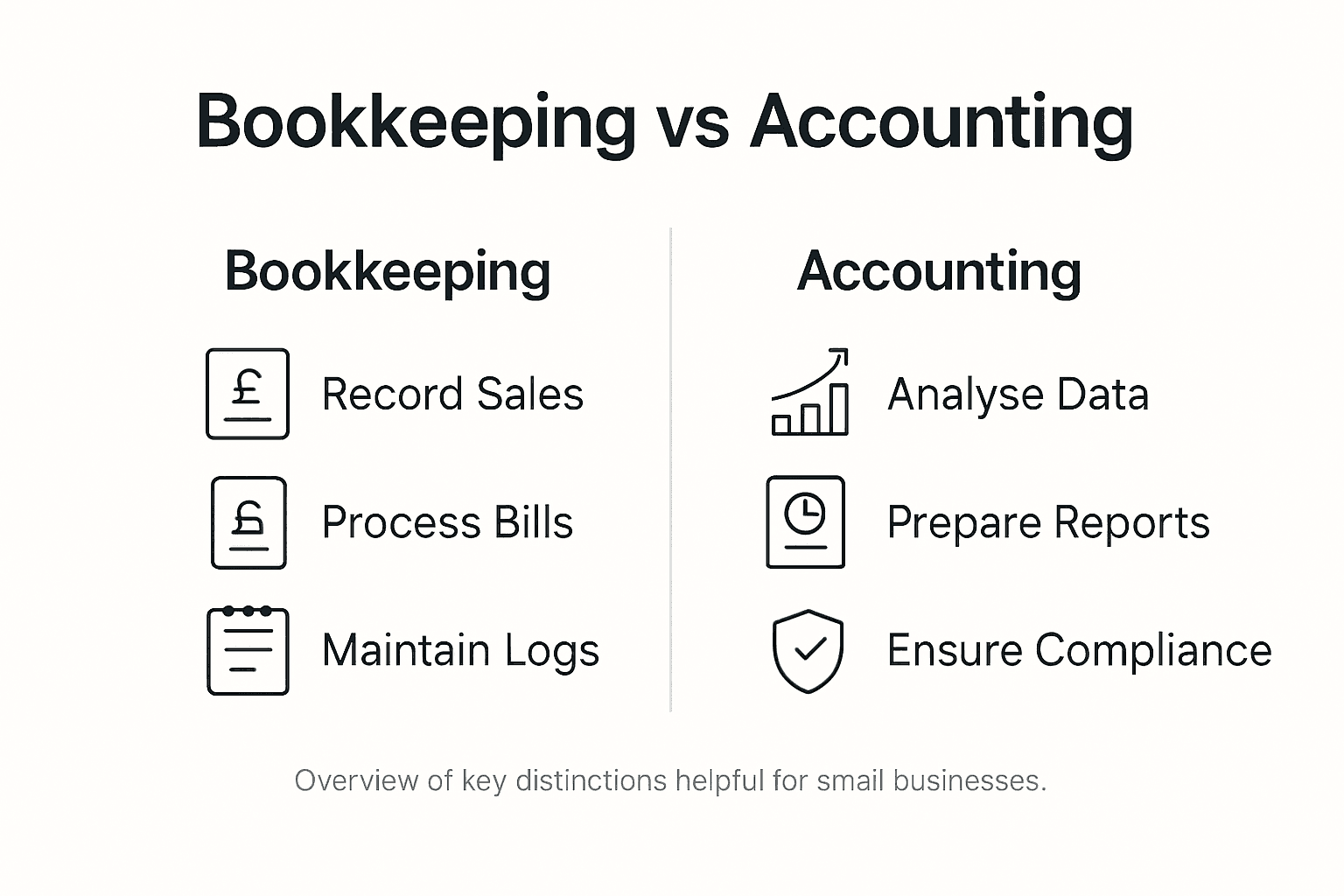
Bookkeeping and accounting might seem interchangeable to many small business owners in Leeds and beyond, but these financial practices have distinct roles and responsibilities. At their core, bookkeeping represents the systematic recording of financial transactions, while accounting involves interpreting, classifying, and summarising those financial records to provide strategic insights.
The fundamental difference lies in scope and complexity. Bookkeeping is essentially the foundational process of tracking every financial movement within a business - recording sales, purchases, payments, and receipts with meticulous precision. Advanced bookkeeping skills involve preparing comprehensive financial statements, requiring a detailed understanding of financial documentation and record management. Accounting, by contrast, takes these recorded transactions and transforms them into meaningful financial narratives that guide business decision-making.
When examining the legal and regulatory landscape, research exploring financial practices highlights the unique tasks, principles, and policies governing these disciplines. Accountants typically handle more complex responsibilities such as tax planning, financial analysis, and compliance reporting. They provide strategic advice, interpret financial data, and help businesses understand their fiscal health beyond simple transaction recording.
Expert Business Tip: Invest in professional bookkeeping services early to ensure accurate financial records, which will save significant time and potential compliance headaches when your accountant needs to prepare annual reports and tax submissions.
To clarify the distinct roles and business value of bookkeeping and accounting, see the comparison below:
Aspect | Bookkeeping | Accounting |
Main Focus | Recording transactions | Interpreting financial records |
Typical Activities | Documenting sales, expenses, payroll | Financial analysis, tax planning |
Required Skills | Attention to detail, organisation | Analytical thinking, regulation knowledge |
Business Impact | Ensures accurate day-to-day records | Guides strategic decision-making |
Key Roles and Responsibilities Compared
In the financial management landscape, bookkeepers and accountants perform distinctly different yet interconnected roles that are critical for small businesses in Leeds and beyond. Bookkeepers are the meticulous record-keepers, responsible for the day-to-day financial documentation that forms the bedrock of a company’s financial health. Their primary responsibilities include recording transactions, maintaining ledgers, processing invoices, managing payroll, and ensuring every financial movement is accurately captured and categorised.
Accountants, by contrast, occupy a more strategic position in financial management. They take the detailed records prepared by bookkeepers and transform them into meaningful financial insights. Understanding individual roles and responsibilities becomes paramount in maintaining organisational financial accountability. An accountant’s toolkit includes financial analysis, tax planning, preparing comprehensive financial statements, offering strategic business advice, and ensuring compliance with HMRC regulations. They interpret financial data, identify potential risks, and provide recommendations that can significantly impact business growth and financial strategy.

To illustrate the differences more clearly, consider their respective scopes: A bookkeeper might record every business expense, categorise transactions, and reconcile bank statements, while an accountant would use those same records to predict cash flow, recommend tax efficiencies, and help develop long-term financial strategies. Their work is complementary - bookkeepers provide the raw data, and accountants convert that data into actionable business intelligence.
Expert Business Tip: Create a clear communication protocol between your bookkeeper and accountant to ensure seamless information transfer and more accurate financial insights for your business.
Legal Duties and Recordkeeping Requirements
Bookkeeping and accounting professionals must navigate a complex landscape of legal responsibilities that extend far beyond simple number crunching. Statutory requirements demand meticulous attention to detail, with businesses obligated to maintain comprehensive financial records that comply with HMRC regulations and Companies Act standards. Understanding individual roles and responsibilities becomes critical when managing organisational record-keeping requirements, particularly for small businesses in Leeds and across the United Kingdom.
For bookkeepers, legal duties primarily revolve around accurate transaction recording, maintaining precise financial documentation, and ensuring all financial movements are transparently captured. They must preserve financial records for a minimum of six years, a requirement mandated by UK tax legislation. This includes maintaining detailed ledgers, recording income and expenditure, preserving invoices, receipts, bank statements, and payroll information with exceptional accuracy.
Accountants bear additional legal responsibilities that extend beyond record maintenance. They are professionally obligated to interpret these financial records, ensure tax compliance, prepare statutory accounts, and provide strategic financial guidance that meets regulatory standards. Their role includes verifying the accuracy of financial statements, conducting thorough financial assessments, and representing businesses during potential HMRC investigations or audit processes. Limited company compliance requirements add another layer of complexity to their professional obligations.
Expert Business Tip: Implement a robust digital record-keeping system that automatically timestamps and securely stores financial documents, ensuring you meet legal requirements while simplifying potential future audit processes.
Cost Implications for Small Businesses
Small businesses in Leeds and across the United Kingdom face critical financial decisions when determining their bookkeeping and accounting strategies. Professional financial management represents a significant investment, with costs varying dramatically based on business complexity, transaction volume, and chosen service model. Professional qualification courses offer cost-effective pathways for businesses seeking to enhance their financial skills, providing alternative approaches to managing financial documentation and reporting.
Typically, bookkeeping services are less expensive than full accounting services, with hourly rates ranging from £25 to £75 depending on complexity and professional expertise. Small businesses might expect to spend between £50 and £250 per month for basic bookkeeping, whereas comprehensive accounting services could range from £150 to £500 monthly. Advanced bookkeeping qualifications can provide small businesses with more affordable in-house financial management capabilities, potentially reducing long-term external service expenses.
The cost differential reflects the distinct value propositions of bookkeepers and accountants. Bookkeepers provide essential transaction recording and basic financial organisation, functioning as the foundational layer of financial management. Accountants, by contrast, offer higher-value strategic insights, tax planning, financial analysis, and compliance support - services that can potentially save businesses significantly more money than their professional fees. Small business tax strategies can substantially offset professional service costs, making professional financial support a strategic investment rather than a pure expense.
Expert Business Tip: Conduct a comprehensive cost-benefit analysis of your financial management approach, comparing the potential savings from professional accounting services against their upfront expenses to determine the most financially prudent strategy for your specific business needs.
Choosing the Right Support for Your Needs
Selecting appropriate financial support is a nuanced decision that requires careful consideration of your business’s unique circumstances and growth trajectory. Professional financial management demands a strategic approach, recognising that different stages of business development require varied levels of financial expertise. Businesses can leverage professional qualification courses to understand their specific support requirements, enabling more informed decision-making about financial resource allocation.
Small businesses should conduct a comprehensive assessment of their financial complexity before engaging bookkeeping or accounting services. Key evaluation criteria include transaction volume, regulatory compliance needs, financial reporting requirements, and anticipated business growth. A sole trader with minimal transactions might benefit from basic bookkeeping services, whereas a rapidly expanding limited company would require more comprehensive accounting support that includes strategic financial planning, tax optimisation, and detailed compliance reporting.
The decision-making process involves evaluating several critical factors: internal financial management capabilities, budget constraints, time availability, and the potential return on investment from professional services. Some businesses might opt for a hybrid approach, combining periodic professional accounting consultations with day-to-day bookkeeping managed in-house. Others might require full-service support to navigate complex financial landscapes, particularly when dealing with multiple revenue streams, international transactions, or intricate tax scenarios.
The table below outlines financial support options chosen by small businesses at different growth stages:
Business Stage | Preferred Support | Key Considerations |
Sole Trader | Basic bookkeeping | Low transaction volume |
Growing SME | Part-time accountant | Compliance and growth planning |
Expanding Company | Full-service accountancy | Complex reporting and tax needs |
Hybrid Approach | Internal bookkeeper, external accountant | Cost-effective, flexible support |
Expert Business Tip: Create a detailed financial support matrix that maps your current business requirements against potential service models, allowing you to identify the most cost-effective and strategically aligned financial management approach.
Unlock Clear Financial Management with Expert Bookkeeping and Accounting Support
Understanding the crucial differences between bookkeeping and accounting is a vital step for small business owners facing challenges around accurate recordkeeping, effective financial analysis, and compliance with HMRC regulations. This article highlights common pain points such as managing day-to-day transactions, navigating tax planning, and ensuring seamless communication between bookkeepers and accountants. If you find these responsibilities overwhelming, you are not alone.
At Concorde Company Solutions, we specialise in providing tailored financial services designed to relieve these pressures. Whether you need precise bookkeeping to keep your daily records in order or comprehensive accounting support for strategic insights and statutory compliance, our expert team in Garforth, Leeds, is ready to help. We understand the emotional weight of financial uncertainties and offer transparent pricing alongside personalised advice, making your journey towards streamlined financial management clear and confident.
Experience the peace of mind that comes from partnering with a dedicated professional who understands your business needs.
Embrace the perfect balance between accurate recordkeeping and insightful accounting today.

Ready to simplify your financial operations and ensure compliance with confidence? Discover how our accounting and bookkeeping services can transform your business. Visit Concorde Company Solutions now to take the next step towards financial clarity and control.
Frequently Asked Questions
What is the main difference between bookkeeping and accounting?
Bookkeeping involves systematically recording financial transactions, while accounting focuses on interpreting, classifying, and summarising those transactions to provide strategic insights for business decision-making.
What are the typical activities performed by a bookkeeper?
A bookkeeper’s responsibilities primarily include recording sales, expenses, payroll, processing invoices, and maintaining accurate ledgers to ensure every financial movement is captured.
What skills are essential for accounting compared to bookkeeping?
Accounting requires analytical thinking and a solid understanding of financial regulations, while bookkeeping emphasises attention to detail and strong organisational skills.
How can small businesses benefit from hiring a professional bookkeeper or accountant?
Hiring a professional can ensure accurate financial records and compliance with legal requirements, ultimately guiding strategic decision-making and potentially saving the business money through tax efficiencies.
Recommended

Comments